Rig-Release® Remote Releasing Hook - Consider The Possibilities...
Work faster and safer on your next challenging job and release your rigging remotely.
Can the load be released accidentally? When used properly the Rig-Release® can not be accidentally released under load.
Why does the Rig-Release® Hook have a minimum capacity? In order for the safety mechanism (LOCK & CAPTURE) to work, you must be lifting at least the minimum stated capacity on the Rig-Release® Hook being used.
Why can't the Rig-Release® Hook be released under load? Once a load is applied to the Rig-Release® Hook, it's Inner Body Assembly sets into a "LOCK & CAPTURE" position and can not be released. Refer to page 5 for details.
Where can I get the Rig-Release® Hook inspected or serviced? Only at the factory in Rockford, Illinois.
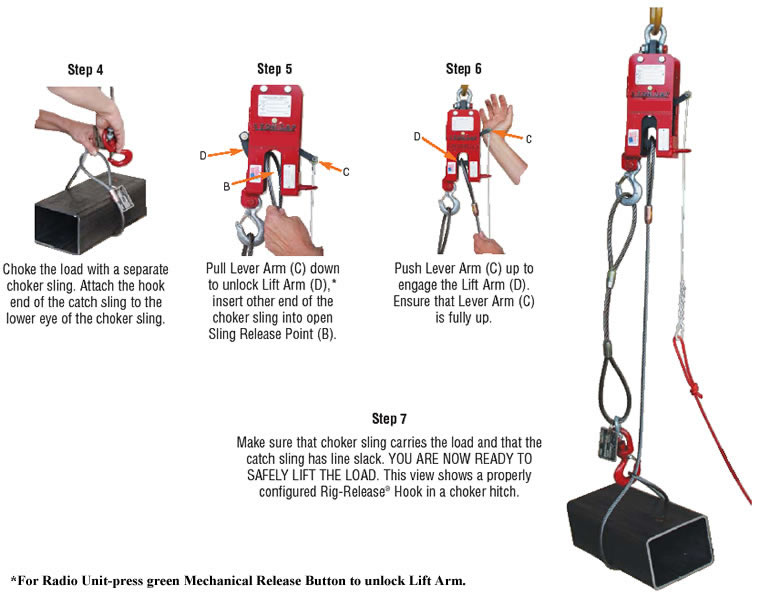
Can I choke loads and use the Rig-Release® Hook? Yes, a catch sling is required in addition to the load sling. Refer to "Rigging The Rig-Release Hook - Choker Hitch" section below for details.
Do I still have to unhook the rigging from the load? No. By design, a properly rigged Rig-Release® Hook removes the rigging from the set load when the crane hook is raised up.
Can I pick up a load at full rated capacity using only the strip sling hook on the Rig-Release® Hook? Yes, the Rig-Release® Hook is designed to support the full rated capacity from either attachment point.
Does the released rigging fall to the ground? No. A properly rigged Rig-Release® Hook has one end of the rigging attached to it at ALL TIMES.
Can I use it with all types of slings? It is recommended that only wire rope slings of the proper rating and capacity are to be used with the Rig-Release® Hook. A nylon sling or chain could be used if they have an oblong attached to them, consult factory for details.
Why is a wire rope sling attached to the Rig-Release® Hook in TWO places? One end is for its release from the Rig-Release® Hook and the other end holds the rigging so that it can be stripped from the load and not fall to the ground.
Rigging Configurations
General Rigging Configurations Both hooks shown carrying a load with the Inner Body Assembly in the LOCK & CAPTURE position.
STEP BY STEP
Rigging The Rig-Release® Hook - Basket Hitch
As soon as the load is applied to the Rig-Release® Hook, the Inner Body travels DOWN which is the LOCK & CAPTURE position. In this position, the load CAN NOT be released. *For Radio Unit-press green Mechanical Release Button to unlock Lift Arm.
Releasing The Rig-Release® Hook
Once the load is set and the crane line is slack, the Inner Body Assembly can travel up. Now releasing can be accomplished by pulling on a rope laynyard (Manual Units) or pushing a button (Radio Controlled Units).
(Manual Unit Shown)
Rigging The Rig-Release® Hook - Choker Hitch
Standard Applications
Questions on Manual Units (Rope Lanyard controlled)
On the Manual Unit, which is rope lanyard controlled, if the rope gets hung-up, will it release the load? No, the rope has a breakaway chain which will yield and break if excessive force is applied. This protects the Rig-Release® from severe damage. Even if the breakaway chain was removed, no amount of force on the rope will allow the hook to release under load.
If the rope breaks, how do I release the load? You would have to do this manually, by going up and releasing the rigging and bringing the Rig-Release® Hook to the ground for proper repair.
Setting Vertical Columns
Perfect For Steel Roof Trusses
Short span trusses can be handled one at a time, or in a bundle.
Use two Rig-Release® Hooks in conjuction with a spreader beam on long span trusses.
Questions on Radio Controlled Units
What is the range or distance of the Radio Remote Control (Transmitter)? The Rig-Release® Hook will work up to 400 feet with a clear line of site. Field conditions, type of rigging used, weather, and battery charge can also affect performance.
If I accidentally push the "RELEASE" button on the transmitter, what happens? Nothing! To activate the Rig-Release® Hooks releasing mechanism, two buttons need to be pushed in the proper sequence. The first button is the "ARM" button and the second is the "RELEASE" button. They must be pushed in this order.
If I accidentally push the "ARM" button and then accidentally push the "RELEASE" button, can I accidentally disconnect the rigging? The two button release procedure sequence is timed. Once the "ARM" button is pushed, you have only 10 seconds to push the "RELEASE" button. After 10 seconds, the transmitter is timed out and you must start the release sequence from the beginning.
Setting Trusses is a breeze
If both buttons were accidentally pushed in the right order and within 10 seconds would the load release? When properly loaded, the Rig-Release® Hook is in the LOCK & CAPTURE position and the Lift Arm and Mechanical Release Button are physically blocked and can not open.
2.5 ton Rig-Release® Hook ready to be rigged
Setting header steel
Are there different frequencies for different hooks? All standard Radio Controlled Rig-Release® Hooks work on the same frequency which is 418 MHz*. This allows for the controlled release of multiple Rig-Release® Hooks using a single transmitter (refer to Instruction Manual).
* Alternative frequencies available, refer to Rig-Release Options.
How long does the battery last? Generally a battery will hold its charge for an eight hour shift, but it depends upon the lifting cycle. All Radio Controlled Rig-Release® Hooks come with two rechargeable batteries.
2.5 ton unit using a choker hitch
What else comes with the Radio Controlled Rig-Release® Hook? Two rechargeable 12 VDC batteries, one transmitter, one 110 volt battery charger and one 12 volt vehicle charger adapter.
Columns high or low - The Rig-Release® Hook does it all!
Special Applications
Rig-Release® Remote Releasing Hook Consider The Possibilities.
Remember, if you can lift it with a sling then you can set the load and release it remotely from a safe distance.
Bio-Hazard:
Four 2.5 ton Radio Controlled Rig-Release® Hooks are attached to a custom designed Caldwell Model 27 Four Point Lifting Beam. This allows the user to lift and dispose of biohazard medical waste bags without the need for a worker to "suit-up" and manually release the rigging.
Specialized Hook Configuration Three units shown to release rigging sequentially. The first piece rigged is the last piece set and released. This dramatically reduces crane time.
Specialized Hook Configuration Spreader beam used with two hooks for simultaneous releasing of the rigging using choker hitch.
Reference Instruction Manual for proper use of multiple hook configurations.
Rig-Release, Remote Releasing Hook, Electronic Release, Remote Release Hook, Slings, and Sling from your complete source for material handling equipment.